Wednesday, August 09, 2006

These green fields are a sight for sore eyes, relaxing, beautiful. Unless we see them as grass to be mown, as one more thing we have to take care of...Then, by our very thoughts, we create a prison from within our own minds... Posted by Picasa

Tuesday, August 08, 2006

Is FELDENKRAIS The Answer?


"It is a mistake to believe that a thought system based on lies is weak. Nothing made by a child of God is without power. It is essential to realize this, because otherwise you will be unable to escape from the prison you have made."

- A Course In Miracles


Is FELDENKRAIS the answer to everything? No. Absolutely not. It is only a means to an end, not an end in and of itself.

If you love to eat as much as I do, (growing up in Switzerland makes one appreciate both cooking and gastronomic finesse!) you know you have to do other things to burn calories! For myself, I ride my horse at least three days a week, and if I am cross training, I make sure she (my horse) gets exercise and turn out. When my horse is in training, I ride at least five days a week to get us both in shape, moving well and strong enough to gallop cross country at 35 miles an hour over solid jumps. Yet, we also need to still be balanced enough to do the sharper turns in the stadium jumping arena, and agile enough to do the graceful sideways moves that make up the balletlike patterns of classical dressage. It's a tall order. However, I do FELDENRKRAIS because it lends me the experience of earlier days. I feel much younger than my 44 years!

When I am cross training, I run, I ski, I swim, I walk. Walking will always be the best way to burn lactic acid, making the muscles less sore and permeating them with the oxygen vital to healthy muscle function. My first experience of this was years ago, when I went to Ireland for a five day horseback ride around the ring of Kerry. What an idylic voyage! As we crested the low mountains of Kerry, I became ever more curious to view the other side. I gleaned a sense of the compulsion for new territory that drove the early settlers of America ever westward. We traveled thirty miles a day over hill and dale on sure-footed Irish Thoroughbreds. Yet, at the end of the day, saddle sore and weary, the best cure and surety of good mobility the next morning was a slow walk along the verdant country roads before heading to bed.

I highly recommend whatever exercise you prefer. What you love is what lights you up. Granted, there are other methods of exercise that overlap with what FELDENKRAIS has to offer. Yet, there is a singular benefit to ATM, and that is that it improves your ability to particiapate in any other activity you set your hand or your mind to do. In my own experience, I can tell you that I tried a semester of yoga at school in college. I was in my early twenties and you would think it would have been easiest for me then. It was a basic Hatha Yoga class. However, I found it difficult and although the philosophy spoke to me, the physical aspect of it did not. What amazes me is that twenty years later, after getting a serious foundation of ATM, I went back to try some Yoga and found it EASIER! Riddle me this Batman, how could it be that a forty year old found Yoga easier than a twenty year old?

But lets recap some of the options. Tai Chi, for example teaches you to ground yourself more firmly in connection with your skeleton. This is an excellent practice that improves your mobility and your bodyawareness. As does Yoga. Yoga is at least as multidimensional as ATM. It also ecompasses the physical, mental and emotional aspects of experience. Yet, it is more invasive. It's about pushing the envelope. It's about stretching. Whereas FELDENKRAIS is about respecting your limitations. What's appropriate for you depends on where you are on the journey. Pilates is a really interesting choice because it not only builds strength, it teaches you to mobilize yourself from the inside and to reorganize yourself to include the deep muscles of your core in your self image. But, even pilates is easier with FELDENKRAIS!

The reason for this is that our limitations, in terms of movement, are usually self-imposed, assuming we have had no major accidents or surgeries. But even accidents are often survived without major misshap. The misshap occurs as a result of apprehending pain, of attempting to prevent anguish by blocking, holding and bracing against an impending incident that may never materialize. It takes energy to try to fend off every possible disomfort. Constantly scanning the environment for potential disaster is a perpetual drain. The practice of ATM all0ws us to knock down the walls of our own making. It first trains us to perceive the walls we have built to protect ourselves from further harm. Next, we look to see if how we feel is a true reflection of what we intend for we may think we fully intend to be open and freely mobile. Finally, we get to bridge the gap between awareness and intention. ATM is a call for accountability with SELF in a way that no other form of movement offers. Not only are you called to notice the discrepancies, you are given the means to work with yourself to break down the walls of limitation, even if you don't really understand what they are. By learning to open the door to your own innate intelligence and potential, you open yourself up to improvement without really having to understand how it works. Just recieve it in gratitude for what it is and be glad for 'not knowing'.

At first 'not knowing' seems difficult and uncomfortable. But it is a gift. It's an opening. It means you are truly teachable. Ask any of the philosophers of ancient Greece and you will find that this is exactly where you want to be. Ask any of the philosophers of our own time, and you will find that being in 'not knowing' grounds you in the present. This, of course, is the only moment we have any power over at all. Old blueprints of how to move, how to think and how to act may govern how we behave, but we can change all that by becoming present. As Eckhardt Tolle says, "The Moment of Power is NOW".

Check out www.eckharttolle.com for a new sense of being present. For more on A Course In Miracles, check out http://www.facim.org/acim/description.htm

Sunday, August 06, 2006

How Long Does It Take?

How open are you to change? How much change can you accept before you get overwhelmed and put on the brakes? How long it takes to experience significant change depends, in part, on your ability to absorb and adapt.


People new to the FELDENKRAIS Method often want to know how long it will take to see significant change. The short answer is that you may experience adequate improvement in one session. However, what is 'adequate'? My question to you, is to ask if you are willing to experience more than just doing okay. What if you could see your way clear to allowing that perhaps, just maybe, there might be a possibility that you could feel better than you remember feeling in a long while?

The more extensive answer is that it would be good to try at least five live ATM classes, supplemented with two to three Functional Integration sessions to have a basic idea of what the work is about. Then you get a little more than 'adequate' improvement, you get a glimpse into what is possible - qualities of improvement that may otherwise not even occur to you.

The really long answer to this question is that it depends. It depends, in part, on you and

a.) your ability to learn
b.) your ability to notice small differences and
c.) your ability to stay open to new experiences.
As a practitioner working with you, my job is to give you a sense of new possibilities.

Your ability to learn is, in fact improved by doing FELDENKRAIS, because movement is the basis of all learning. Improving our ability to track movement is a newly forged link between you and the innate intelligence of your nervous system.

Your ability to notice small differences allows you to integrate change. First you are given the opportunity to feel yourself from a completely different perspective: one of relaxed attention without strain. From this point of view, you may experience life very differently than you do now. Then, when you go out into the world, you can choose to either go back to ignoring what you have become aware of, or, you can notice how some of the small differences you noticed in class or in your session can create a domino effect in your daily life. Utilizing theses changes is up to you. We all have free will. When you make the connections, spontaneous improvements can occur.
Your ability to stay open to new experiences determines how much benefit you will experience. This is because the fundamental premise of the work is to show you parts of yourself, both habits, postures, attitudes, and ways of relating that you have hitherto been unable to see, feel or notice. You see, our habits are like old clothing, so comfortable we hardly feel them. Yet, when scrutinized, you may find that they are pretty ratty and that you may want to change them out for something new.
If all you want, is to get rid of the pain you came in with, that may be a project or it may happen very quickly, depending on how old the issue is. But you may discover that more than that is possible and find yourself engaged in a process that takes the rest of your life.

This, certainly, was my experience. I have always been interested in lifelong learning, as a means of fending off boredom, but this is different. This is like a voyage into the unknown where things are possible that I would never have thought to ask for. What kinds of things? Like having the ability to sit upright with the ease of a toddler. Like being taller than I was before instead of growing shorter as I age. Like feeling a sense of having more space inside my body. Like finding my two 'left feet' on the dance floor have disappeared! Like seeing old mental thought patterns and emotional reruns fall away effortlessly. Like the sense that colors are more vibrant, the earth under my feet more welcoming and the world I live in infinitely intriguing. May I invite you to share this journey with me? Would you like your life to be more fulfilling?


Thanks to Feldenkrais Practitioner Ralph Strauch of Pacific Palisades CA for his comments on this subject. Check out some of his ideas - careful - it may change your reality: http://somatic.com/create.exp.html

Thursday, July 21, 2005

Yoga Develops Body Awareness Too, Why ATM?

How is the practice of AWARENESS THROUGH MOVEMENT different from a yoga practice or tai chi or some other form of physical movement? One of it's main characteristics is that it improves your ability to learn. As a result, you become quicker at learning other skills - any other skills that interest you. Another characteristic is that it's primary goal is to develop the kinestetic sense intentionally. Other similar movement practices do help develop the kinesthetic sense, but to a much smaller degree. Yet, what you cannot see is not evident, especially in our culture, so, most people find it hard to comprehend why these two applications of the Method have the potential to change your life completely.


In this photograph, a woman is playing a piano with her whole self. The fact that the piano is not there only serves to emphasize that her entire self is engaged. Her posture, her mind, most likely her heart, not just her hands, are all organized to meet the keys in an expression of her internal experience transmuted into sound.

For most of us, as beginners at any skill, there is always a nagging part of ourselves that is complaining. Complaining about the position we have to maintain to continue. Complaining about not understanding where this is going. Complaining about why it isn't easier. It is only after one gains a modicum of skill that a new dimension enters the fray. Enter into the zone, where all thought is lost, all consciousness of time released, all senses are channeled into the task at hand. It is a place that paradoxically is timeless and yet has incredible presence. By many, it is called flow. When you are in it, your whole self is engaged.

AWARENESS THROUGH MOVEMENT (ATM) is a way to learn to enter into the zone of flow consciously, rather than via music, or drawing, or painting or acting, or singing, or writing, or sports, or study, or tai chi, chi gung, or yoga. By cultivating a sense of what flow feels like in general, it is possible to go there on purpose instead of by accident. ATM teaches us how to intentionally generate flow, rather than have it happen as a capricious accidental experience. For those who relentlessly chase the muse, ATM is an amazing boon, for this state, like inspiration, comes more easily to those who are open to it, rather than those who pursue it.

This has some really practical applications in addition to the airy fairy ones that appeal to people with a creative bent. Life is full of tasks that need doing, tasks that are not especially exciting, like doing dishes, taking out the garbage, or getting the laundry done. Oh, boy, let me jump out of bed now and get down to the brass tacks of living. If this is not your immediate response, how can you make chores more interesting for yourself? Once you know the principles of ATM kinesthetically, you can make any activity into an ATM. An ATM is just a form, like a kata in the martial arts, that teaches you how to be more present as a primary goal rather than a secondary goal as in yoga or martial arts, for example.

Working out of a yoga studio, I often run into students who figure they are already doing things to increase their awareness, why bother with ATM? When I first started doing ATM, I too, had a pretty good level of body awareness from years of receiving various kinds of massage to deal with the repercussions of multiple whiplash and concussion injuries. I was better off than the average person on the street, but still not comfortable in my own body. Ironically, I had just enough body awareness to realize that I was doing it to myself, but no clue what to do about it. For a while I tried to make myself relax whenever I noticed I was holding muscles tight without realizing it. I almost drove myself crazy. Let me save you the trouble. It cannot be done.

One of the major differences between Yoga and ATM is that ATM generates length in the resting muscles using movement rather than stretching. Stretching is a mechanical act that doesn't change how the nervous system sets the resting length of the muscles. If you stretch often enough, the muscle will change it's resting length and the nervous system will adapt and assume that to be the norm. If you only stretch once in a while, however, often you will wake up with muscles shorter than they were the day before. The alternative is to learn to use your consciousness along with movement in the way of ATM, and what happens is that your nervous system adjusts the resting length of your muscles. It's like hitting the reset key on your computer. The nerves that control the muscles recalibrate. Since that is usually how muscles function, via a response to nerve stimulus, it seems to a rather less invasive approach. It honors resistance rather than challenging it.

Having had my hands on several thousand people over the years as a body worker, I can attest to the fact that people who stretch a lot have much more dense muscle tissue than people who achieve that lengthening via ATM. Dense is not better in terms of muscle physiology. A dense muscle has to work harder to accomplish basic normal functions like receiving nutrients and getting rid of the by-products of energy production. A healthy muscle is soft, springy and has a lot of space and fluid circulating inside it. It requires lubrication, ease of nutrient and oxygen flow, ease of ridding itself of metabolic wastes (i.e. circulation).

The first series of five ATM lessons I did was enough to realize that my body held incredible levels of tension that I had absolutely no control over. It took longer than that, however, to learn the principles of ATM in such a way that I could apply it to anything that required movement. I slowly learned to make movement in any situation pleasant and comfortable. People who have little body awareness generally carry so much tension that it's amazing they can function at all because their muscles are fighting against each other. The extensors are contracted at the same time the flexors are trying to contract and vice versa. There is no off switch. Living in such a body is like living with an accident waiting to happen. Having a sense of body awareness merely let's you in on the fact that you carry too much tension. ATM teaches you what to do about it to learn to fix it yourself. This is the most significant difference between yoga and ATM. When you learn to unkink yourself, you are able to go places you wouldn't risk going otherwise. Thus, ATM can make the journey of yoga even more of an adventure.

Friday, July 01, 2005

Living In Perpetual Postponement?

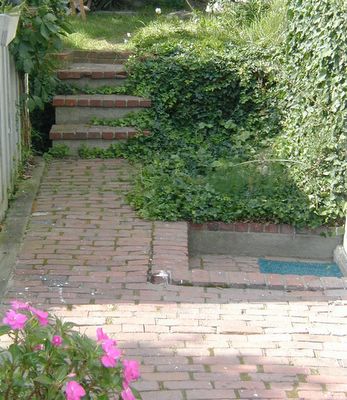
Funny how photographs can frame the environment selectively, so that there is an emphasis on a stair or a flower. Usually there is an intentional use of proportion by the photographer to create a sense of balance. Reality is like that also. Unwittingly, we see a version of the world that is framed by our vision, or our lack thereof. The problem is, the framing often is unconscious, given that we are usually unaware of the basic assumptions we make that govern what we see. Taking time for ourselves allows us a chance to start to see what is usually hidden from view. Posted by Picasa

"The hardest thing to see is what is in front of your eyes." - Goethe


Have you ever caught yourself thinking that someday you will start taking better care of yourself, or that someday you have every intention of getting into nutrition or exercise or meditation? If you live in this land of 'someday, maybe,' the question you have to ask yourself is do you really want to feel better? Superficially, you may think, 'Of course, I want to feel better.' If you take a deeper look, is there some payoff that keeps you from taking the first steps towards change? What are you really attached to? What really moves you?

Looking back on your life, how do you see it overall? What is it that you notice first? Do you see mostly the best things that ever happened to you? Or, do you see your life as a series of difficulties? These first impressions of your overall experience provide clues to your unconscious self image. In the FELDENKRAIS METHOD, it's a given that we all have preferences that govern our choices, our behavior and our results. The most startling aspect of this, however, is that these predispositions are so deeply ingrained that they even govern how we approach things we have never done before. In other words, we have habits about how we do things we don't even know how to do. AWARENESS THROUGH MOVEMENT (ATM) is ingeniously designed to use movement lessons couched in the totally unfamiliar to make those habits more readily apparent. This is a practice that can facilitate seeing the preferences that for the most part go unnoticed. Certainly the signifigance of how powerfully they affect our lives goes unnoticed.

Ben Franklin said, 'A small leak can sink a great ship.' Many such small leaks will sink it faster, no doubt. Having a self image perforated with habits of thought that lead to permanent postponement is like riding the crest of a wave in a leaky boat. There's the Scarlette O'Hara approach, 'I'll think about that tomorrow.' Today is a survival emergency. Time enough for comfort later, when the potatoes are harvested. A more modern offshoot of that is the myth of the woman who can do it all, birth babies, bring home the bacon, keep the house and bake cookies too. No time for self in that scenario. I am not suggesting that work is bad. But workaholism can be just a self-absorbed as egotism. I am not advocating self-absorption either; merely taking time to notice, periodically, what is going on under the surface. Shimmering waters can be deceptive.

These underlying attitudes usually become apparent at some point during life's less pleasant moments anyway. Why wait until your hand is forced? It's a lot more painful to wait until strong emotions run rough shod over your plans than to regularly take the time to peak under the carpet. Needless to say, a single dust bunny is easier to deal with that an entire carpet laden with dirt.

An ATM practice affords the opportunity to notice the amazing grace of life before it disappears. It brings presence to moments we let slip through our fingers. It teaches us to find the immediacy necessary to stop living a life of endless postponement. How? By the simple expedient of honing those amazing senses we so readily take for granted like life itself. We rarely think about how awesome it is to be able to see, unless, for some reason, our vision is taken away by injury or disease. Hearing can be a gift or a curse according to what the noise level is around you. For music I am eternally grateful. For now, I am focused on my own internal rhythm in spite of the construction going on outside.

Four thousand years of human experience in disciplines like yoga, chi gong, and meditation attest to the fact that amazing results can be acheived by focusing on the very act of breathing. What makes ATM different? ATM provides a frame for channeling your attention so that beginning is easy. ATM teaches you how to focus your mind, so that the overwhelming glut of information that modern living belches onto your desk no longer dominates your experience. ATM provides a refuge that is not religious, not concerned with striving, acheiving or struggle. It's part art, part science. It's derived from Martial Arts, Child Development, and the principles of Engineering as they apply to living structures moving in the field of gravity.

It's a much more gentle beginning than some of the aforementioned disciplines that have evolved over the centuries. It can provide similar benefits, glimpses into a more fulfilling consciousness, greater mobility, comfort and energy, but in a way that invites through the playful curiosity that motivates children to learn spontaneously. ATM is unique in that it concentrates on living from the inside out rather than from the outside in. It is not cosmetic like many of the values of our times, rather it is fundamental. It sheds clarity on our relationships with self, with others and with the world. In my view, this is exactly what the world needs; people skilled at seeing the big picture, within and without at the same time. The somatic approach is even more inclusive than that, for it includes vision, taste, smell, sound, feeling, and choice based on what works rather than unconscious preferences. ATM is a practice of non-judgement not out of moral superiority, but because judgement is about attachment to personal outcome, which actually hinders the ability to hear, see and feel what works.